Profile:
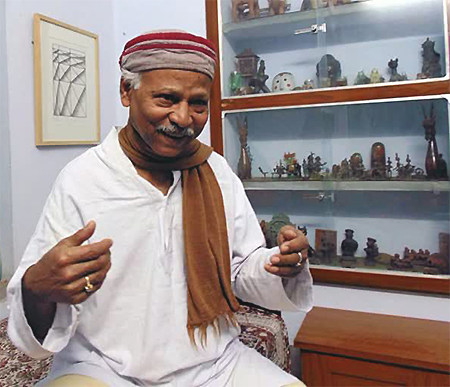
Sushen Ghosh was an important Indian modernist sculptor and educator whose practice developed within the intellectual environment of Santiniketan while extending into an individual language of abstraction based on geometry, rhythm, music and the movement of forms through space. Born in 1940 in Silchar, Assam, Ghosh spent much of his professional life at Kala Bhavana, Visva-Bharati, Santiniketan, first as a student and subsequently as a teacher in its influential Department of Sculpture.
Although he remained comparatively removed from the commercial art world for much of his career, Ghosh’s contribution to post-Independence Indian sculpture was substantial. His sculptures evolved from early figurative concerns towards increasingly distilled and abstract forms in which geometry, proportion, balance and rhythm became fundamental. His work occupies an interesting position between the sculptural modernism inherited from Santiniketan and the international abstraction that he encountered during his period of study in Britain.
Santiniketan and Early Training
Ghosh grew up in Silchar and received a Government Scholarship to study at Kala Bhavana, Santiniketan, in 1959. There he encountered one of the most important artistic environments in twentieth-century India.
His teachers and mentors included Ramkinkar Baij and Benode Behari Mukherjee. The broader intellectual legacy of Nandalal Bose, particularly the emphasis placed on rhythm as a fundamental organising principle in art, also became important to his development.
Ramkinkar’s influence was especially significant. Rather than encouraging imitation, the Santiniketan tradition emphasised observation, experimentation with materials and the discovery of an individual relationship between form, environment and lived experience. Ghosh absorbed these principles while gradually moving towards a more abstract sculptural vocabulary.
He completed his Diploma in Fine Arts and Crafts at Visva-Bharati in 1963. Soon afterwards, he was invited to join the Department of Sculpture at Kala Bhavana as a teacher, beginning an association with the institution that would continue for more than four decades.
From Figure to Abstraction
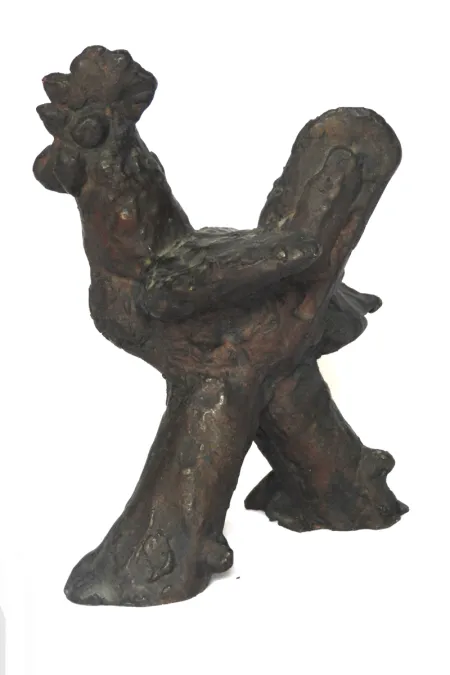
Ghosh’s early sculptures retained recognisable references to the human figure. Yet even at this stage, his primary concern was not narrative representation but the underlying organisation of form.
A review of his 1968 solo exhibition at the Academy of Fine Arts, Kolkata, noted the strength of his modelling and the manner in which clean, sweeping lines combined rhythm with monumentality. The observation is important because it identifies qualities that would remain central to his mature work even after he moved decisively away from figuration.
During the late 1960s and early 1970s, recognisable bodies gradually gave way to increasingly simplified volumes, curves, planes and geometric relationships. Sculpture became less an image of something seen than an investigation into how forms occupy and activate space.
London and the Development of a Modernist Vocabulary
A decisive moment came when Ghosh received a British Council Scholarship in 1969 to pursue advanced study at Goldsmiths in London.
His time in Britain brought him into direct contact with European modernism. He studied in an environment associated with Henry Moore and encountered original works by artists including Constantin Brâncuși, Amedeo Modigliani, Henri Matisse, Paul Klee and Paul Cézanne, as well as the formal ideas associated with the Bauhaus.
These encounters strengthened an inclination towards abstraction that had already begun in Santiniketan. Yet Ghosh did not simply adopt a Western modernist vocabulary. After returning to India, he brought these experiences into dialogue with Santiniketan’s understanding of nature, rhythm and material, and with his own engagement with Indian music, philosophy and mathematics.
The resulting language cannot comfortably be described as either exclusively Indian or Western. It was an individual modernism constructed through the interaction of both.
Sculpture as ‘Frozen Music’
Music provides perhaps the most revealing way of approaching Sushen Ghosh’s sculpture.
Ghosh was himself a flute player and maintained a serious engagement with Indian classical music. Musical ideas of rhythm, interval, repetition, pause and progression increasingly informed the organisation of his sculptural forms.
For Ghosh, sculpture could operate almost like a musical composition translated into three dimensions.
A curved plane might function like a melodic phrase; repeated elements could suggest musical notation; an interruption or empty space could operate like silence between notes. Solid mass and surrounding emptiness were therefore not opposites but interdependent components of a single composition.
This relationship between music and sculpture led to his memorable conception of sculpture as a kind of “frozen music.”
Yet there is nothing static about his best work. The viewer’s eye travels along curves, edges and intervals, discovering changing relationships as one moves around the sculpture. What appears still contains an implied movement.
Geometry, Mathematics and Space
Geometry became increasingly important in Ghosh’s mature practice.
Circles, arcs, verticals, horizontal planes and carefully calibrated proportions appear repeatedly. However, geometry was not employed merely to achieve formal purity. Ghosh was interested in the philosophical and perceptual possibilities hidden within mathematical order.
His sculptures investigate relationships between mass and void, movement and stillness, symmetry and imbalance, finite form and seemingly infinite space.
The empty spaces surrounding and penetrating his sculptures are therefore as significant as the material itself. A void may separate two elements while simultaneously connecting them visually. Forms may appear stable from one position and unexpectedly dynamic from another.
Through such relationships, Ghosh sought what might be described as movement within stillness — an attempt to discover the structure underlying visible form.
Nature, Architecture and Indian Visual Traditions
Despite the apparent austerity of his abstraction, Ghosh remained attentive to nature and historical Indian art.
His drawings after the sculptural figures of Konark and the terracotta reliefs of Bishnupur, particularly during the 1970s, demonstrate his interest in extracting movement and rhythm from traditional forms rather than copying their iconography.
A dancer, musician or architectural fragment could be reduced to its essential directional energies. Ornament disappeared while movement remained.
This process parallels his sculpture: the visible world provided an initial stimulus, but observation was gradually transformed into a more fundamental language of rhythm and structure.
Materials and Monumentality
Ghosh worked across a range of sculptural materials and scales. His practice included intimate studio sculptures as well as large-scale and monumental installations at Santiniketan.
Even his smaller sculptures often retain a sense of monumentality. This does not depend simply on physical size. It emerges from the clarity of proportion, the tension between volumes and the confidence with which a form establishes itself within surrounding space.
Conversely, his large sculptures rarely become merely imposing objects. Their carefully controlled intervals and rhythmic relationships retain an intimacy associated with drawing and musical notation.
Preparatory drawings formed an important part of this process. They reveal how apparently simple sculptural structures emerged through sustained consideration of line, proportion, movement and spatial relationships.
Teacher at Kala Bhavana
Ghosh’s contribution to Indian sculpture extends well beyond his own studio practice.
After completing his studies, he joined the Department of Sculpture at Kala Bhavana, where he taught for more than forty years. Visva-Bharati’s institutional history identifies him among the important teachers who helped sustain and develop the sculpture department established under Ramkinkar Baij.
His position placed him within a remarkable pedagogical lineage. He had entered Santiniketan as a student of some of its foundational modernists and subsequently became a teacher to later generations of sculptors.
In this sense, Ghosh acted as an important bridge between the pioneering experiments of early Santiniketan modernism and the increasingly diverse sculptural practices that developed in India during the later twentieth century.
Later Recognition and Lyric, Still
Despite the depth of his practice, Ghosh remained relatively little known outside specialist artistic circles during much of his lifetime. His quiet personality and distance from the commercial gallery system contributed to this relative obscurity.
A major reassessment came with Lyric, Still in 2023, conceived as the first substantial survey of approximately five decades of his practice.
Presented first by Project 88 in Mumbai from 10 August to 2 September 2023, and subsequently by Galerie 88 in Kolkata from 7 October to 30 November 2023, the exhibition brought together sculpture and preparatory drawings and demonstrated the remarkable consistency of his enquiry into abstraction, geometry, philosophy and musical rhythm.
Sadly, Ghosh did not live to see the completed retrospective. He died at his home in Santiniketan on 18 April 2023, aged 83.
The exhibition consequently became both a retrospective and a posthumous reassessment of an artist whose contribution had remained insufficiently documented within mainstream histories of Indian modernism.
Association with Aakriti Art Gallery
Aakriti Art Gallery has contributed to the documentation of Sushen Ghosh’s practice. Significantly, in November 2010, Aakriti published the essay Notations and Rhythm in Space: Sushen Ghosh, examining his progression from figuration towards abstraction and the importance of rhythm, geometry and his experience in London to the development of his sculptural language.
This early documentation is particularly relevant because it predates the wider reassessment of Ghosh’s oeuvre that followed his death by more than a decade. It recognised the formal importance of an artist whose contribution to modern Indian sculpture had often remained outside the dominant narratives of the market.
Legacy
Sushen Ghosh occupies a distinctive position in modern Indian sculpture.
He emerged directly from the great Santiniketan tradition of Nandalal Bose, Benode Behari Mukherjee and Ramkinkar Baij, but resisted becoming merely a continuation of it. His experience in London broadened his understanding of international modernism, while music, mathematics, philosophy and his observation of Indian artistic traditions enabled him to construct an independent language of abstraction.
At the centre of this practice was a deceptively simple question: how can a static material contain movement?
His answer lay in rhythm.
Curves become phrases, intervals become pauses, geometric forms establish relationships comparable to musical notes, and empty space becomes an active component of the composition. Sculpture, in his hands, could be solid and weightless, silent and musical, still and simultaneously in motion.
The renewed attention given to his work after 2023 has begun to restore Sushen Ghosh to a more appropriate position within the history of post-Independence Indian sculpture — not simply as an accomplished Santiniketan sculptor and influential teacher, but as an original modernist whose quiet investigation of form, rhythm and space produced one of the more distinctive abstract sculptural languages to emerge from twentieth-century Bengal.