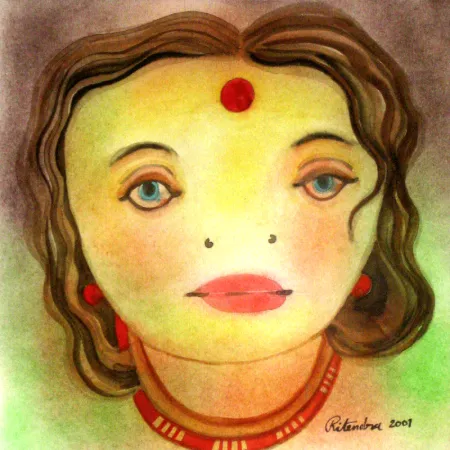
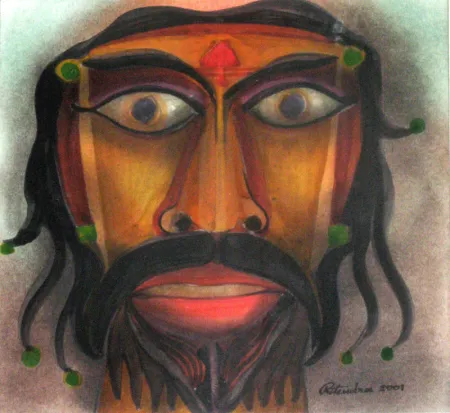
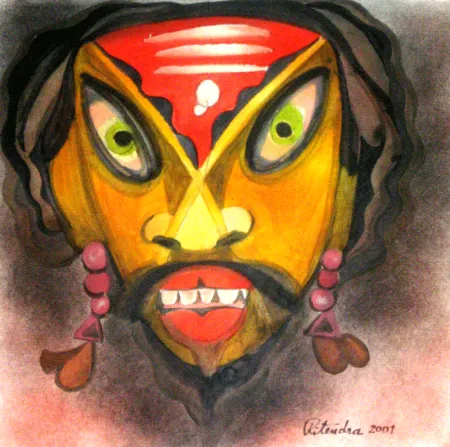
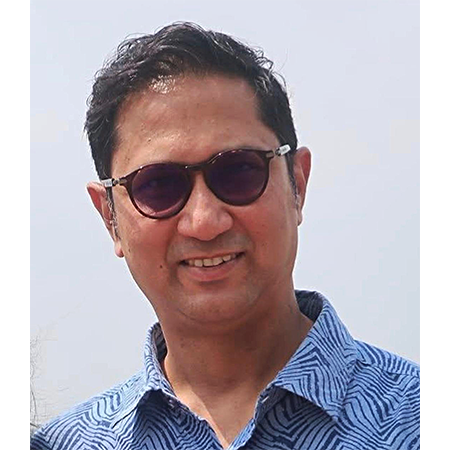
Ritendra Roy is a contemporary Indian painter, art educator, writer and curator whose practice explores the relationship between geometry, architecture, light, shadow and lived space. Born on 11 March 1972, he lives and works in Kolkata and has been professionally engaged with visual art for more than three decades. Alongside his studio practice, Roy has made sustained contributions to art education, criticism, curatorial practice and institutional administration in West Bengal.
Roy graduated in Visual Arts from Rabindra Bharati University, Kolkata, in 1997, and completed his postgraduate studies at Visva-Bharati, Santiniketan, in 1999. He subsequently earned a Ph.D. from the University of Calcutta.
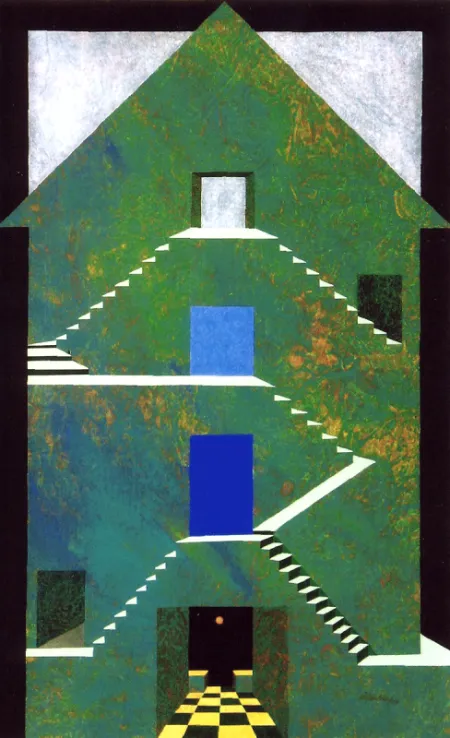
His academic training provided the technical foundation for a practice that gradually moved beyond conventional representation towards an individual investigation of constructed space. Architecture, geometric planes, shadows, reflections and fragments of familiar objects became recurring elements through which he examined the uncertain boundary between what is physically present and what is visually perceived.
Geometry Beyond Abstraction
Geometry occupies an important position in Roy’s paintings, but his work cannot be adequately described as geometric abstraction.
This distinction was articulated most clearly in his important solo exhibition Progress of Non-Abstract Geometry at Aakriti Art Gallery, Kolkata, in 2010. The exhibition title itself identified a central contradiction within his practice: geometry could organise a painting without necessarily removing it from the world of observable reality.
Aakriti’s contemporary critical essay accompanying the exhibition traced this concern back to Roy’s student years at Rabindra Bharati University. In an academic still life, for example, he had treated the cast shadows of foliage almost as substantial forms in their own right. This early interest in the tension between object and shadow, substance and illusion subsequently developed into a defining element of his mature paintings.
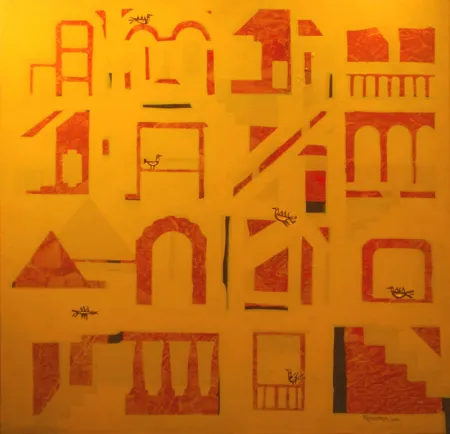
Roy’s geometry therefore does not operate as an autonomous system of circles, rectangles and lines. It frequently originates in architecture and the constructed environment.
Walls become planes.
Windows create divisions.
Light produces geometry.
Shadows acquire apparent solidity.
The result is a visual world in which the familiar is reorganised without entirely losing its connection to reality.
Architecture, Light and Shadow
Architectural space is among the most recognisable elements of Roy’s visual language.
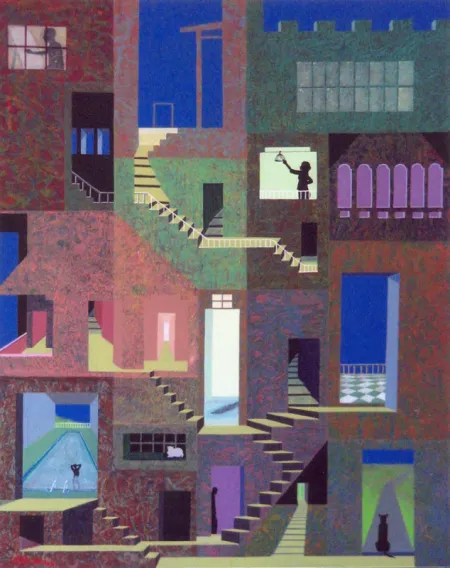
Buildings, interiors, structural divisions and intersecting planes appear repeatedly, although they are rarely represented as straightforward architectural studies. Instead, the artist extracts from architecture its underlying geometry and uses it to construct ambiguous pictorial environments.
Aakriti’s 2010 essay identified a relationship between this aspect of Roy’s practice and the legacy of Gaganendranath Tagore, particularly his use of light and shadow within architectural compositions. In Roy’s paintings, similarly, light is not simply used to illuminate an object. It becomes a structural element capable of producing planes and altering the viewer’s understanding of physical space.
The distinction between solid structure and projected shadow can consequently become uncertain.
A wall may appear transparent.
A shadow may seem more substantial than the object producing it.
One plane appears to recede while another unexpectedly advances.
Through these ambiguities, Roy turns architecture into a psychological as well as a physical environment.
A contemporary review of the 2010 Aakriti exhibition likewise noted the angular architectural character of his paintings and compared them to Gaganendranath’s architectural constructions. The review particularly drew attention to Roy’s images of the interiors of high-rise buildings and his manipulation of blended colour and geometric contours.
The Familiar Made Uncertain
Although architecture provides an important framework, Roy’s paintings also incorporate familiar objects and forms.
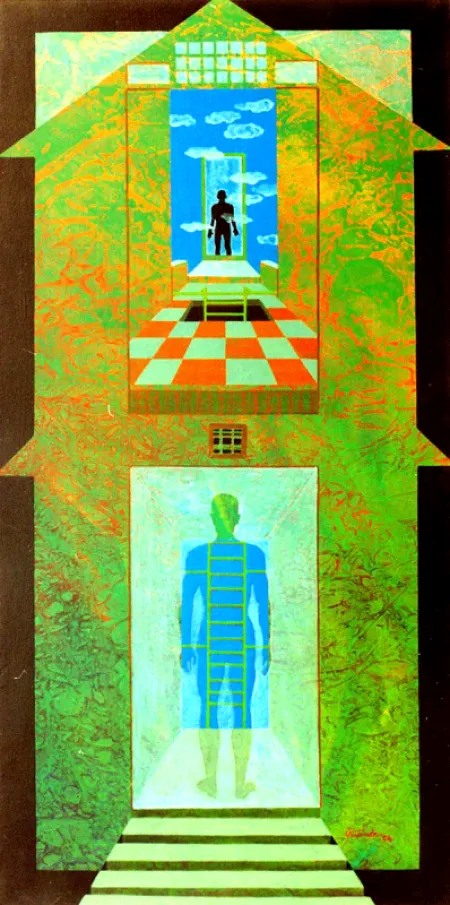
Vessels, pitcher-like shapes, fragments of streets, domestic objects and occasional human presences enter carefully constructed pictorial spaces. These recognisable elements prevent the paintings from becoming purely abstract.
At the same time, their relationships are often deliberately uncertain.
An object may reflect a pattern that appears to belong elsewhere. Surfaces may seem simultaneously opaque and transparent. Scale can shift subtly, and apparently rational architectural spaces may contain visual contradictions.
This tension between recognition and uncertainty is fundamental to Roy’s practice.
The viewer initially encounters something familiar but gradually becomes aware that the apparent logic of the image cannot be completely trusted.
His paintings therefore operate between observation and imagination, material reality and optical illusion.
Colour and Surface
Roy’s handling of colour reinforces this ambiguity.
Rather than employing colour simply to describe objects, he frequently builds surfaces through closely related tonal variations. Colours blend and overlap, creating atmospheric or marble-like effects within otherwise sharply organised compositions.
This produces an important tension between the hard geometry of architectural form and the fluidity of the painted surface.
In some works, vertical drips interrupt carefully constructed structures, allowing the physical behaviour of paint to challenge the apparent precision of the architecture beneath it.
Such contrasts are characteristic of Roy’s approach. Geometry is repeatedly confronted by something less predictable: shadow, reflection, texture, dripping pigment or the ambiguity of perception itself.
Solo Exhibitions
Roy has exhibited professionally for several decades through solo exhibitions, group exhibitions and curated projects in India and abroad.
His documented solo exhibitions include presentations at the Birla Academy of Art & Culture, Kolkata, in 2000 and 2004, and the AIFACS Gallery, New Delhi, in 2002.
In 2010, Aakriti Art Gallery presented his significant solo exhibition Progress of Non-Abstract Geometry in Kolkata. Aakriti’s archive records the exhibition as running from 19 May to 19 June 2010, while contemporary newspaper listings record the public exhibition through 5 June; this discrepancy in published dates is best preserved in the archive rather than silently reconciled.
The exhibition was formally unveiled on 18 May 2010 in the presence of artists and critics including Jogen Chowdhury, Tapas Konar, Chhatrapati Dutta, Bimal Kundu, Atin Basak, Aditya Basak, Manoj Dutta, Pranabranjan Ray and Mrinal Ghosh, among others.
In 2012, Roy presented the solo exhibition Home at Gallerie Ganesha, New Delhi.
His works have additionally been selected for national exhibitions and curated presentations in India and abroad and have entered private collections.
Awards and Recognition
Among Roy’s significant early recognitions is the Abanindranath Tagore Memorial Medal in Painting, awarded by the Indian Society of Oriental Art. His supplied biography emphasises the historical importance of the institution and its origins in the cultural environment established by the Tagore family in pre-Independence Bengal.
Aakriti’s current artwork records additionally document the Nirod Baron Memorial Prize from Rabindra Bharati University in 1999.
These distinctions accompanied a practice that increasingly established Roy within the contemporary art scene of Kolkata and beyond.
Writer, Curator and Art Administrator
Roy’s engagement with art extends considerably beyond his own paintings.
He has written on visual art for academic journals and professional art magazines and has delivered lectures and papers in academic and cultural contexts. His documented engagements include programmes associated with the National Gallery of Modern Art, the Rajya Charukala Parshad, Government of West Bengal, the National Council of Education, Bengal, and the UGC-HRD Centre at the University of Calcutta.
He also worked as an art administrator and curator at Emami Chisel Art, Kolkata, and was associated with its publication Art Etc. as an associate editor. He subsequently participated in the editorial activities of Art East magazine.
These activities reveal an artist engaged not merely with the production of objects but with the broader intellectual and institutional structures surrounding contemporary art.
Art Education
Education has remained another major dimension of Roy’s career.
He serves as Associate Professor and Head of the Department of Visual Arts at the University of Kalyani, West Bengal. The University’s current departmental records confirm both positions and identify him as a faculty member specialising in visual arts.
The Department of Visual Arts itself was established in 2008 and offers postgraduate education in painting with an emphasis on practical experimentation, critical enquiry, environmental and cultural awareness and professional development. Roy’s involvement therefore places his teaching within an academic framework that attempts to connect studio practice with wider intellectual enquiry.
His supplied biography further records that the University recognised his academic and administrative leadership in 2014, and that he has served on academic boards of universities offering UGC-recognised courses in Visual Arts.
Association with Aakriti Art Gallery
Ritendra Roy has a documented and substantial association with Aakriti Art Gallery, Kolkata.
The gallery presented his solo exhibition Progress of Non-Abstract Geometry in 2010, an exhibition important not only in his chronology but also in articulating the conceptual foundations of his practice. Aakriti’s accompanying critical writing examined his relationship with geometry, architecture, illusion, light and shadow, providing an important contemporary record of his artistic development.
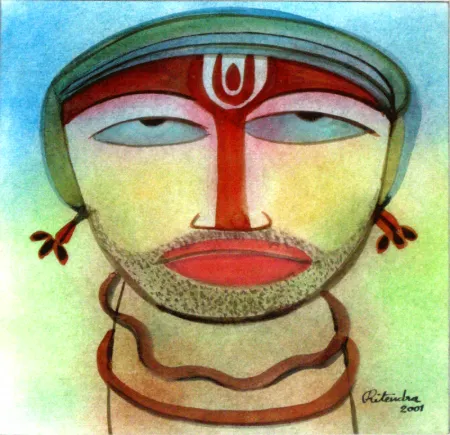
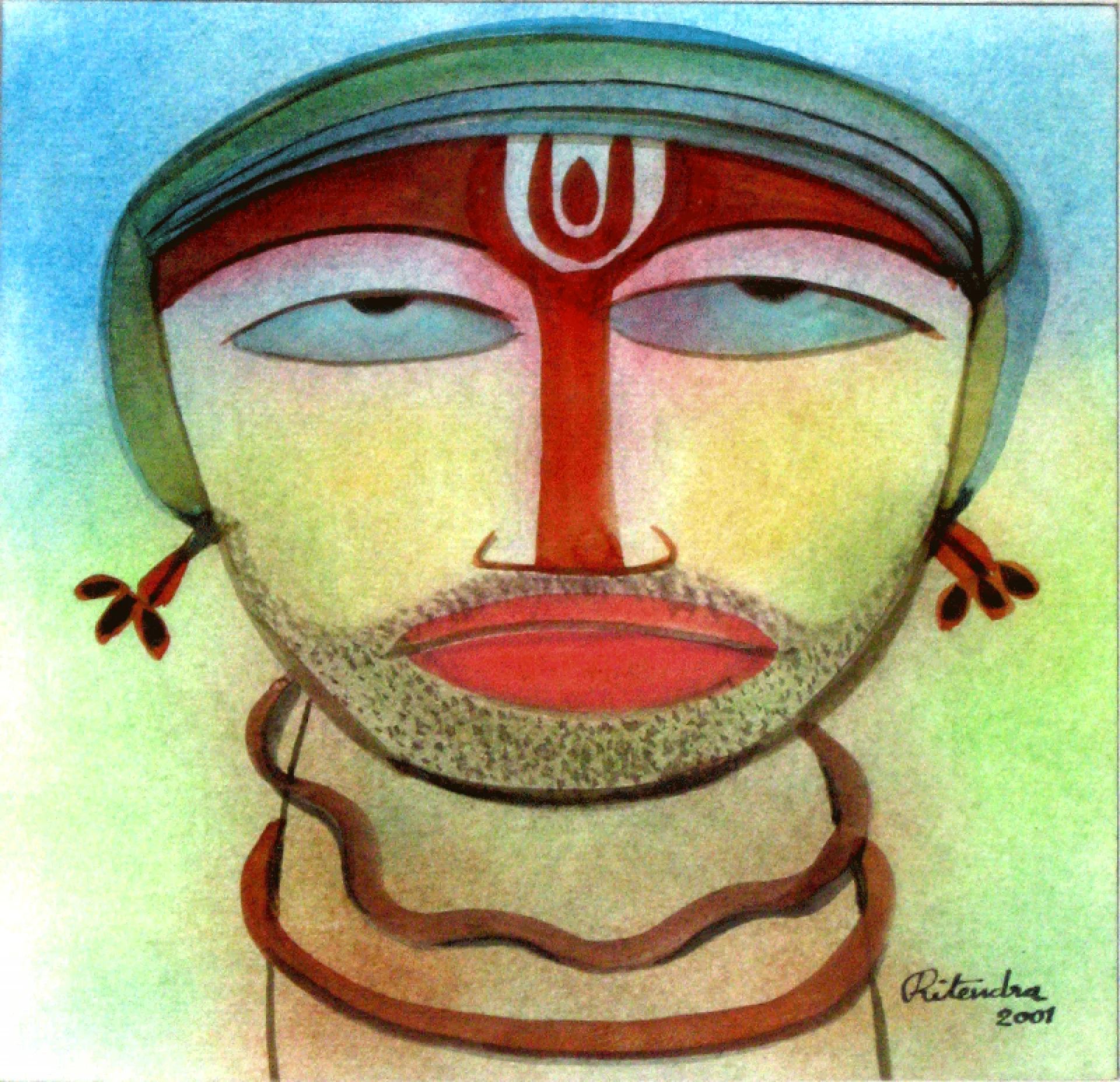
Aakriti continues to hold and present Roy’s work. The gallery’s current collection includes, among other examples, an Untitled acrylic on paper from 2001 with provenance recorded as the artist’s collection, and Euphoria (2019), executed in gouache and graphite on Nepali handmade paper mounted on canvas board, acquired from the artist’s collection.
The association therefore extends across different periods of Roy’s practice and provides an important link between his earlier investigations of pictorial space and his continuing development as a painter.
Continuing Practice
Ritendra Roy occupies an interesting position within contemporary painting in Bengal because his work resists an easy division between figuration and abstraction.
Geometry is present, but it originates in the observed world.
Architecture is recognisable, yet its physical certainty is repeatedly destabilised.
Shadows behave like objects, reflections acquire independent identities and colour can dissolve the boundaries established by line.
His paintings ultimately concern not architecture alone but perception: the difference between what exists, what appears to exist and what the mind constructs from what the eye encounters.
This investigation has remained consistent across his work while developing through changing materials and pictorial strategies. Combined with his parallel careers as an educator, curator, writer and art administrator, it establishes Ritendra Roy as a distinctive figure within the contemporary visual culture of Bengal.
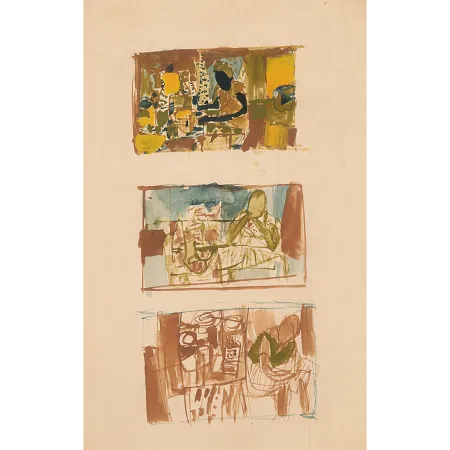
 Untitled