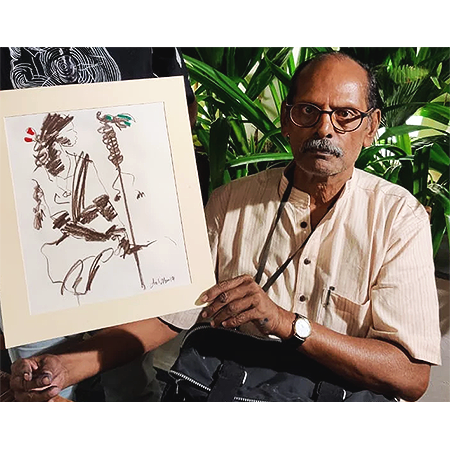
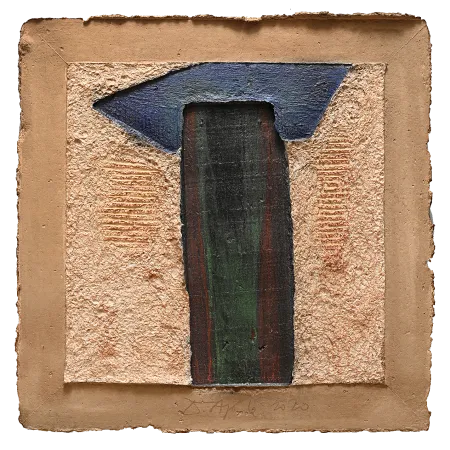
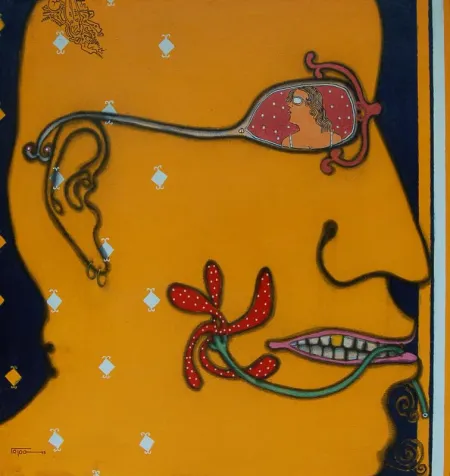
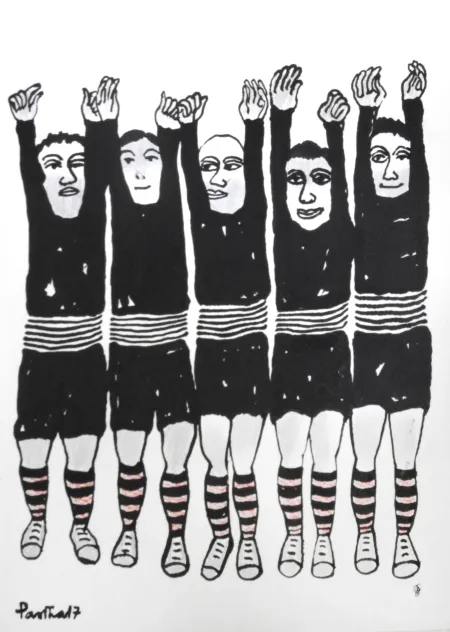
J.M.S. Mani, born J.M. Subramani, was an important painter and art educator from Karnataka whose distinctive figurative paintings brought the people and landscape of Badami into the vocabulary of contemporary Indian art. Born in 1949 in Bangalore, Mani developed a practice spanning painting, drawing, printmaking, watercolour and mixed media, but he remains best known for his celebrated Badami series—powerful images of ordinary men and women rendered with vigorous brushwork, strong colour and heavily worked surfaces.
Although firmly rooted in the visual and social environment of Karnataka, Mani’s work combines local experience with the formal concerns of modern painting. His figures are neither conventional portraits nor ethnographic records. Instead, the inhabitants of Badami—vendors, workers, women carrying baskets, men wearing turbans, balloon sellers and other everyday characters—become monumental presences through which Mani explored colour, form, texture and the dignity of ordinary life.
Training at Ken School of Art
Mani’s formal artistic journey began comparatively late. In 1974, he visited the Ken School of Art in Bangalore, where he encountered its founder, the artist and teacher R.M. Hadapad, working in clay. The meeting proved decisive, and Mani joined the institution as a student. Hadapad became his teacher and mentor and exercised an enduring influence on his artistic development.
Mani subsequently received his Diploma in Drawing and Painting from the Ken School of Art. His relationship with the institution continued long after his student years: he joined its faculty and eventually became Principal, a position he held until his retirement in 2007.
This dual role as painter and teacher made Mani an important figure within Karnataka’s artistic community. His career demonstrates the continuing significance of regional art schools in shaping modern Indian practices beyond the better-known centres of Bombay, Delhi, Calcutta and Baroda.
Discovering Badami
The defining subject of Mani’s career emerged through his relationship with Hadapad, who came from Badami, the historic town in northern Karnataka known for its rock-cut cave temples and dramatic sandstone landscape.
Curious about the place described by his teacher, Mani first travelled to Badami with fellow students in 1975.
The experience had a lasting impact.
He later recalled arriving early in the morning and encountering muddy roads, mountains illuminated by a golden sky, horse-drawn tangas, a bus stop beneath a solitary tree, men in large turbans, banana shops and women washing clothes beside the water. The students made sketches of people as they worked. These observations became the foundation of an artistic engagement that would continue for decades.
Badami consequently became much more than a geographical subject for Mani. It became his principal visual territory.
The Badami Series
The Badami series is the body of work most closely identified with J.M.S. Mani.
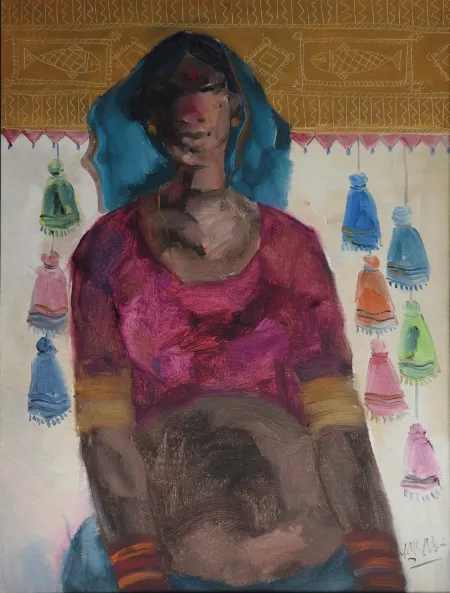
Rather than concentrating on Badami’s celebrated monuments, Mani turned his attention towards its inhabitants. Farmers, market vendors, labourers, women carrying flowers or fruit, men in turbans and figures accompanied by roosters, balloons, kites and bananas populate his canvases.
Mani was attracted to what he perceived as the simplicity, dignity and hardworking character of the people he encountered there. Yet the resulting paintings should not be understood simply as documentary images of rural Karnataka.
Through repetition and transformation, the “Badami Man” and “Badami Woman” became archetypes within his art.
Individual identity is frequently suppressed. Facial features may be simplified or obscured, gestures restrained and narrative detail reduced. What remains is the physical presence of the figure.
A market vendor can consequently acquire almost sculptural monumentality.
Colour, Texture and the Human Figure
Colour is fundamental to Mani’s visual language.
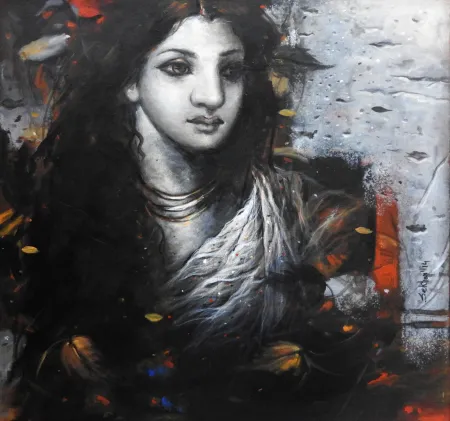
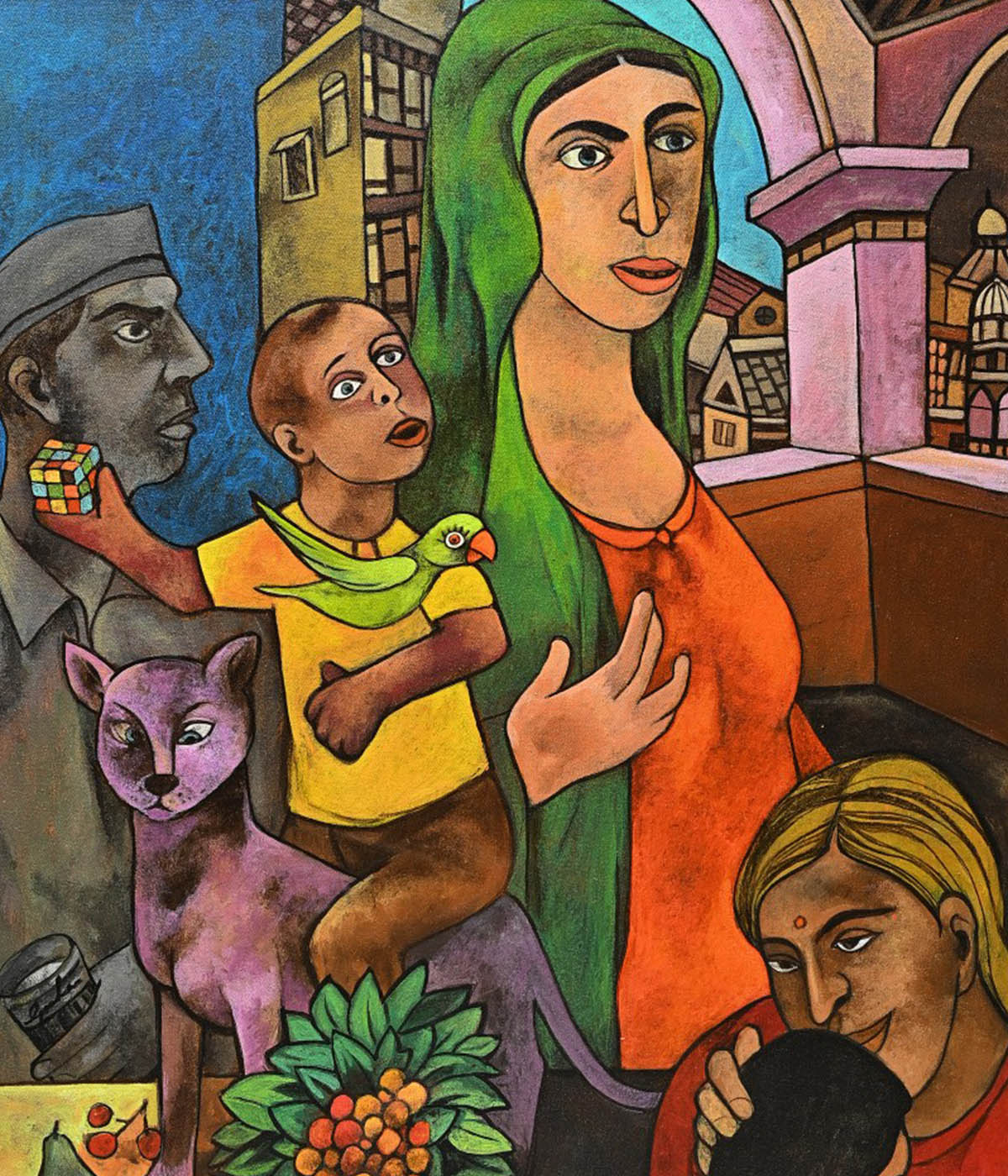
His Badami paintings frequently juxtapose deeply modelled human figures against intense areas of red, yellow, orange, blue and green. Brightly coloured clothing, fruit, flowers, balloons and other objects provide counterpoints to the darker tonalities of the figures.
His brushwork is equally distinctive.
Paint is often applied thickly, producing an impasto surface in which individual strokes remain visible. The materiality of paint becomes an active part of the image rather than merely a means of describing the subject.
This treatment gives his figures an unusual physical density. Faces and bodies appear modelled through paint, almost as though Mani were constructing sculpture upon the surface of the canvas.
His compositions are generally direct and uncluttered. One or two figures may dominate the pictorial field while a small number of objects establish the setting. This reduction concentrates attention upon the relationship between figure, colour and surface.
The emotional force of the paintings therefore often resides less in facial expression than in the overall composition. Saffronart’s documentation of the series similarly observes that Mani’s colour and composition frequently carry greater expressive weight than the restricted gestures of his figures.
Beyond Badami
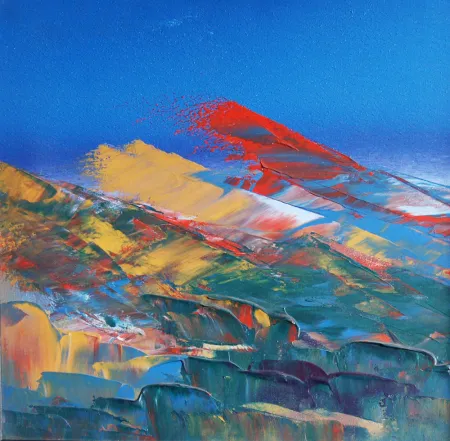
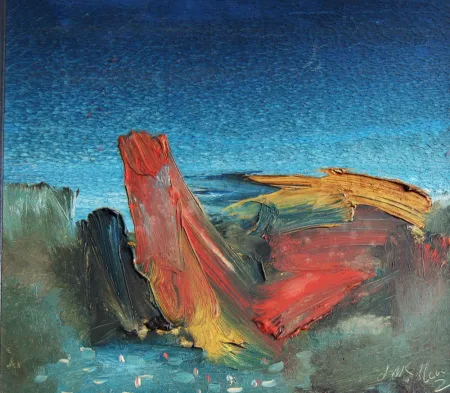
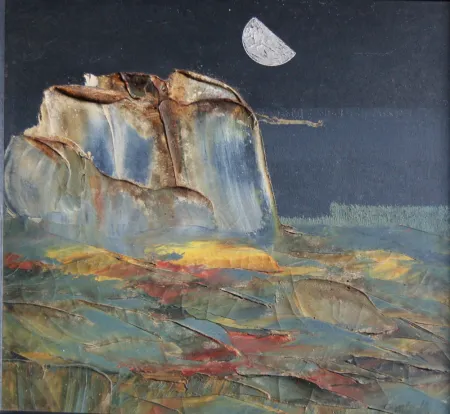
Although the Badami paintings became his signature works, Mani’s practice was considerably broader.
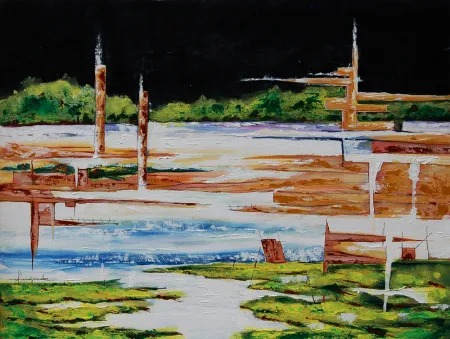
At different stages of his career he experimented with landscape, nature-based abstraction and gestural abstraction, creating images inspired by mountains, trees, monuments and the landscape surrounding Hampi. He also produced a distinct Mother and Child series.
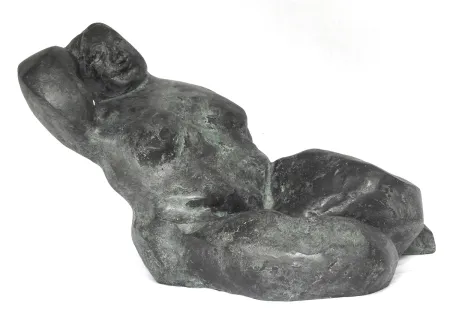
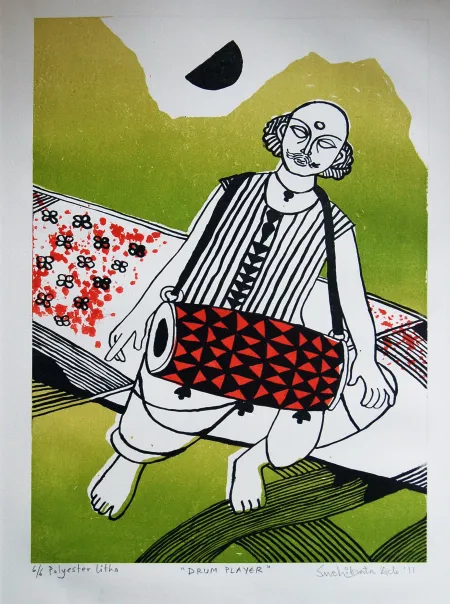
His practice extended beyond oil painting into watercolour, charcoal drawing, printmaking, etching, sculpture and mixed media.
His watercolour landscapes demonstrate another aspect of his temperament. In contrast to the dense physicality of the Badami oils, these works could be lighter and more immediate, relying on fluid washes and economical marks to capture atmosphere and place. Contemporary accounts specifically identify both his watercolour landscapes and charcoal drawings as significant aspects of his oeuvre.
This diversity is important. Mani should not be reduced entirely to a single successful series. The Badami works emerged from a much broader investigation of figuration, landscape, abstraction and material.
Modernism and Regional Identity
One of the most interesting aspects of Mani’s practice is the relationship between regional experience and modernist form.
He did not attempt to reproduce folk art stylistically, nor did he treat village life sentimentally. Instead, subjects encountered in northern Karnataka were transformed through modern pictorial devices—compressed space, simplified forms, expressive colour, thick paint and emphatic brushwork.
The result was a form of modernism firmly located in place.
This gives Mani an interesting position within the history of post-Independence Indian art. His paintings demonstrate that Indian modernism did not develop exclusively through metropolitan centres or through direct engagement with international avant-garde movements. Regional landscapes, communities, teachers and everyday experience could provide equally powerful foundations for an individual modern language.
Exhibitions and International Presence
Mani exhibited extensively from the late 1970s onwards.
Documented solo exhibitions include Bangalore University in 1979, Kritika Art Gallery in 1981 and 1982, and the Regional Centre in Chennai in 1982. During the 1990s his work travelled internationally, with exhibitions including Lee Arthur Studio, New York (1994), Gallery Maya, Hong Kong (1995), the Mall Galleries, London (1995) and a graphics exhibition in Switzerland (1995).
He also participated in numerous group exhibitions and national art events. These included the SAARC Exhibition at Karnataka Chitrakala Parishath, Bangalore, and the Bharat Bhavan International Biennale of Prints in 1989.
His works subsequently entered public and private collections in India and internationally.
Awards and Recognition
Mani received significant recognition during his career. Sources document his receipt of the Karnataka Lalit Kala Akademi Award during the early 1980s, while later accounts record the Karnataka State Award in 2006 and two Lalit Kala Academy awards.
More important than individual awards, however, was the recognisability of the visual language he developed. The Badami figures became unmistakably associated with Mani, an unusual achievement for any artist working within contemporary figuration.
Teacher and Mentor
Mani’s contribution to Karnataka’s art history cannot be measured solely through his paintings.
His long association with the Ken School of Art, first as a student, then as a faculty member and eventually as Principal, placed him within an important chain of artistic transmission. The mentorship he had received from R.M. Hadapad was, in turn, extended to younger generations of artists through his own teaching.
He remained Principal until his retirement in 2007.
This pedagogical dimension distinguishes Mani from an artist concerned only with his personal studio career. For several decades he participated directly in the development of art education and artistic practice in Karnataka.
Legacy
J.M.S. Mani died in June 2021, leaving behind an extensive and immediately recognisable body of work.
His lasting achievement lies particularly in his ability to transform the ordinary inhabitants of one small historic town into enduring protagonists of modern Indian painting.
Badami was already celebrated for its ancient architecture before Mani encountered it. His contribution was to look beyond its monuments and recognise another subject: the people living around them.
Through repeated visits and sustained observation, those people entered his visual memory. The turbaned man, the woman carrying flowers, the banana seller, the balloon seller and other seemingly ordinary figures gradually became part of an invented pictorial community.
His paintings neither romanticise rural existence nor reproduce it literally. Through intense colour, vigorous brushwork, impasto and simplified composition, Mani gives his figures a presence considerably larger than their everyday circumstances.
It is this combination of regional specificity and universal human presence that gives the Badami series its enduring importance. J.M.S. Mani demonstrated that an artist could remain deeply rooted in the visual culture of Karnataka while developing a language unmistakably his own—and, in doing so, secured an important place within the wider history of modern and contemporary Indian figurative painting.
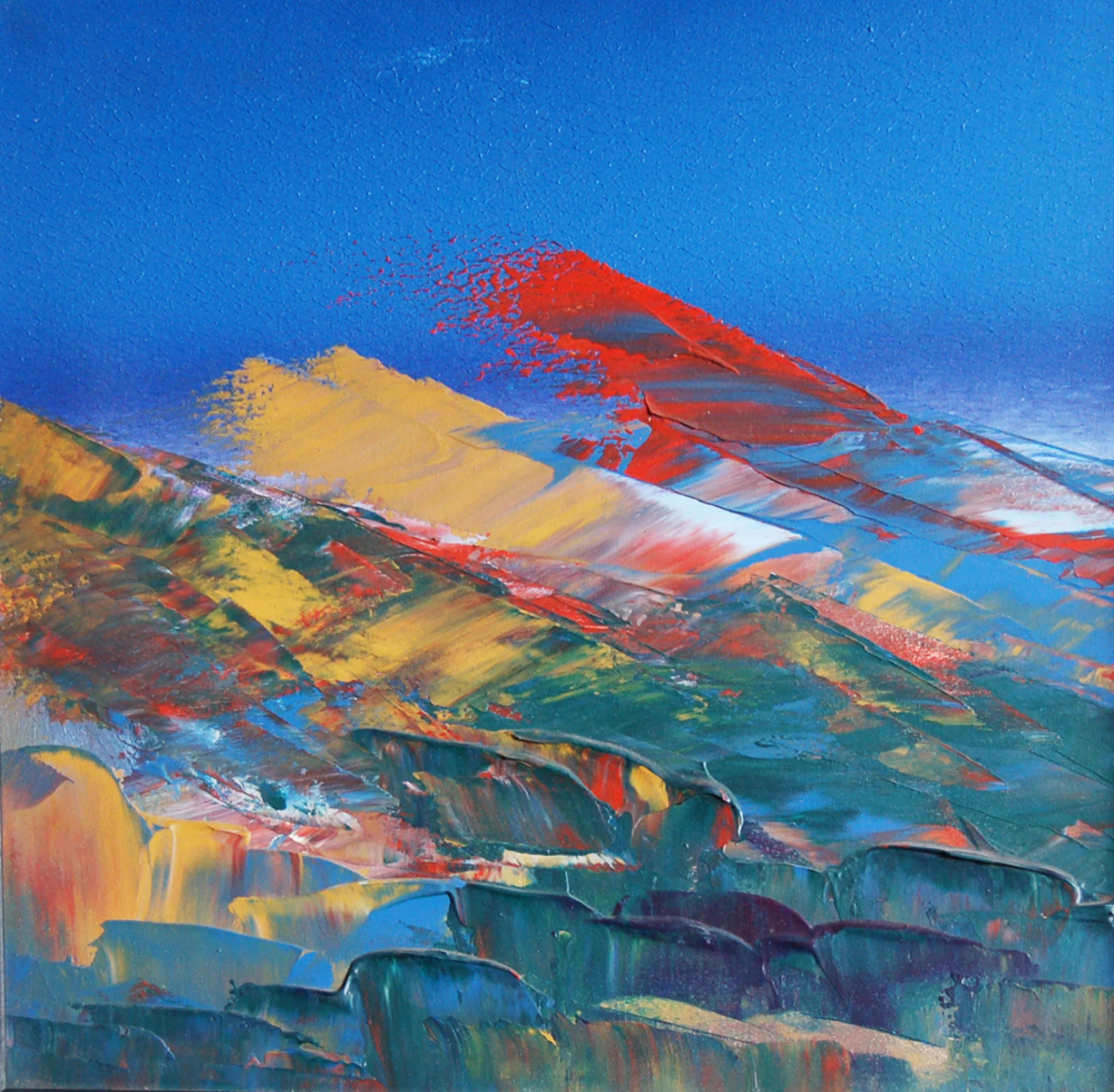 Untitled